
Knowledge Exchange and Impact
Our research has generated evidence-based insights, interventions and policy to improve children’s emotional wellbeing during primary-secondary school transitions. We have achieved those impacts through three interconnected strands of work:
1. Developing and delivering the #P-S WELLS survey, which measures children’s emotional wellbeing in the context of primary-secondary school transitions across Year 5, 6 and 7.
2. Creating and implementing Talking about School Transitions 5-7 (#TaST 5-7), a co-produced 17-week skills-based transitions curriculum that improves children’s ability to manage primary-secondary school transitions.
3. Development of a national primary-secondary school transitions strategy.
Public Engagement
We have worked in partnership with non-academic stakeholders throughout the project (Bagnall et al., 2024b; Testimonial 1). All our work has been guided by two advisory groups: one panel of young people (aged 9-13 years) and a second panel of educational and clinical practitioners, NGOs and policymakers. The panels ensure that our research and the insights we co-produce are meaningful and relevant to our intended beneficiaries. We have also worked hard to translate our research into usable resources. We have produced bespoke analyses and reports for 176 schools and 23 Local Authorities (Testimonial 2; Rochdale CYPP); developed communities of practice, to enable shared learning across 23 Local Authorities (Testimonial 3 & 4); and delivered online and in-person events regionally and nationally, including CPD workshops for Local Authority and school staff, workshops for the Department for Education (2024), podcasts and Newsround articles.
Testimonials:
Testimonial 1: “We have already been part of historic projects that Dr Bagnall has delivered on. The first was looking at the transition from primary to secondary school, in a special school context, and Dr Bagnall worked with pupils, parents and school staff to co-produce a document which has proved invaluable to us. Our pupils responses were so enlightening to the staff that we amended our practices immediately. It was a privilege to be invited to join the #P-S WELLS advisory group” (Special School Head Teacher, Staffordshire)
Testimonial 2: "This year we have partnered with #P-S WELLS to capture pupil voices. We are collaborating with the team to compare pupils' own perceptions of their emotional wellbeing in the context of primary-secondary school transition to the professionals understanding of their needs" (Local Authority Lead, Merton Council)
Testimonial 3: “Being part of #P-S WELLS has connected me with other people interested in school transition, creating a community of practice. Stimulating my own thoughts around developing this further in my local authority” (Local Authority Head, Liverpool)
Testimonial 4: “Being able to partner our work with the #P-S WELLS project had significantly improved our ability to define and create more successful transition experiences for the pupils within our community. Working with the team has allowed us to refine our programmes so they are truly research informed and more importantly given us robust and rich data on the impact of our work and how it affects the social and emotional wellbeing of pupils. Without this partnership and the advice and support from the #P-S WELLS team we would not have been able to take further steps forward in approaching how we also support parents across the transition from primary to secondary which is a hugely important factor in the work we are developing”. (Trust Lead, Stockport)
Workstream 1: Monitoring children’s emotional wellbeing over primary-secondary school transitions
We co-developed the #P-S WELLS survey with our advisory panels, including the core domains, items, and response scale. The #P-S WELLS survey identifies which aspects of primary-secondary school transition children are experiencing emotional difficulties with and when, who might be particularly vulnerable and what support could be useful, on a universal and targeted basis. The survey has been implemented in 176 schools, capturing the views of 8948 children across 23 Local Authorities in England and Scotland; following the same children across Year 5, 6 and 7. Examining the resultant data in collaboration with our advisory panels has significantly improved our understanding of the trajectory of change and variability in children’s emotional wellbeing over primary-secondary school transition.
The survey and its results are informing practice at school and Local Authority level:
(1) 176 schools are using the #P-S WELLS survey to systematically assess and monitor children’s emotional wellbeing over primary-secondary school transition, and are using the data gathered to inform their provision (Testimonial 5 & 6);
(2) 23 Local Authorities are using the #P-S WELLS survey model to inform strategic priorities and subsequent actions (Testimonial 7 & 8).
There has been significant interest from a research, policy and school perspective in embedding #P-S WELLS in transition provision nationally and in Australia (Commissioner for Children and Young People Australia; Australian Government). To facilitate international uptake of #P-S WELLS, we have worked with an international advisory group of practitioners, researchers, policymakers and influencers to ensure that the design of #P-S WELLS is relevant to school transitions in different countries. Currently, we are validating the #P-S WELLS survey in Australia. The data gathered is being used to inform strategic priorities.
Testimonials:
Testimonial 5: “The newly-created scale has advanced our ability to identify pupils who are able to transition from special provision to mainstream schools, by understanding our pupils’ emotional responses to their transition in greater detail, enabling us to tailor our plans for each pupil with greater effectiveness. This has led to teachers being better prepared to support pupils, who ultimately have a more positive and successful transition.” (Special School Chief Education Lead, Staffordshire)
Testimonial 6: “We have seen a much calmer response from our SEND/vulnerable children with regards to the subject of Transition, through the #P-S WELLS project. Any mention of High School or the transition itself is handled with a more positive approach from the children. Just knowing the children have that wider, targeted support there gives the children a reassuring aspect to Y7 transition as a whole. Additional tracking of their progress only aids in supporting their mental wellbeing.” (Y6 Teacher, Doncaster)
Testimonial 7: “Our partnership with #P-S WELLS has enabled us to understand more systematically the challenges our children face at transition. Our partnership has opened up multi-agency conversations about approaches to transition across Liverpool” (Local Authority Lead; Liverpool)
Testimonial 8: “#P-S WELLS has been embedded into the Local Authority Transition handbook, the Children and Young People Partnership Plan, Health action strategy and the data will be used to help early identification for those students that will benefit from additional transition support” (Local Authority Lead, Rochdale)
Testimonial 9: “Your impactful work on improving children’s emotional wellbeing over primary-secondary school transition has transformed our approach to supporting transition in Melbourne and even the Department of Education are now becoming a lot more aware of this need. We are very keen to engage in the validation and international translation of #P-S WELLS” (Educational Practitioner, Melbourne, Australia)
Workstream 2: Design, implementation and evaluation of emotional wellbeing primary-secondary school transitions curricula
Following identification of universal and targeted needs, through the #P-S WELLS survey, schools need the resources, to be able to support children over primary-secondary school transition. In response to those needs, we co-developed a 17-week skills-based transitions curriculum, called Talking about School Transitions 5-7 (#TaST 5-7), with our advisory groups. #TaST 5-7 aims to develop children’s transition awareness, skills and ability to cope with the multiple changes they will experience over primary-secondary school transition.
#TaST 5-7 has been successfully trialled with 1686 Year 5-7 children in 32 schools in the UK (Bagnall et al., 2021; 2024a). Children and teachers found the skills-based and gradual early-intervention approach useful. Children showed a decrease in transition worries and an increase in transition excitement and coping efficacy compared to the comparison group from Year 5 to Year 6, resulting in a lowered impact on internalising symptoms in Year 7. The success of the trial has resulted in national support for #TaST 5-7 as a ‘promising universal school-based intervention that could influence policy and practice nationally,’ and it has been referenced by the DfE (2024), NICE (07/22), and in Health Policy Scotland Guidelines (01/20). #TaST 5-7 is now being trialled in Australia in Victoria State following interest from the Australian Department for Education (Testimonial 10).
Testimonials:
Testimonial 10: “#TaST reduced children’s anxiety, increased their awareness about transition and ultimately gave them the language to feel more comfortable and improved Victoria’s approach and capacity to support primary-secondary school transition” (Mental Health Practitioner; Victoria State, Australia)
Workstream 3: Development of a national primary-secondary school transitions strategy
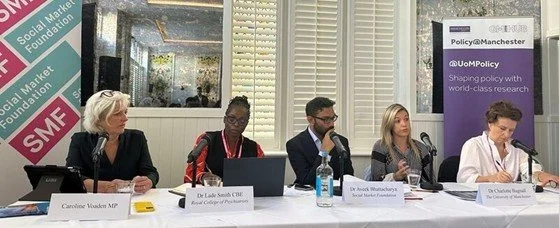
Our approach to supporting children’s emotional wellbeing, through the #P-S WELLS project has been recognised by the Minister for Children, Families and Wellbeing, and at the Liberal Democrat, Labour and Conservative party conferences. Following the Labour conference, an MP tabled a written parliamentary question in support of #P-S WELLS, and another MP met with us and wrote to the Education Minister, advocating for #P-S WELLS to be embedded in a national strategy to monitor children’s wellbeing in the Children’s Wellbeing and Schools Bill.
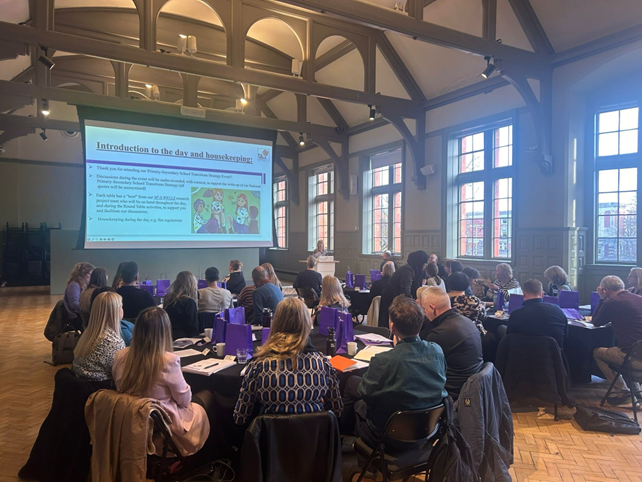
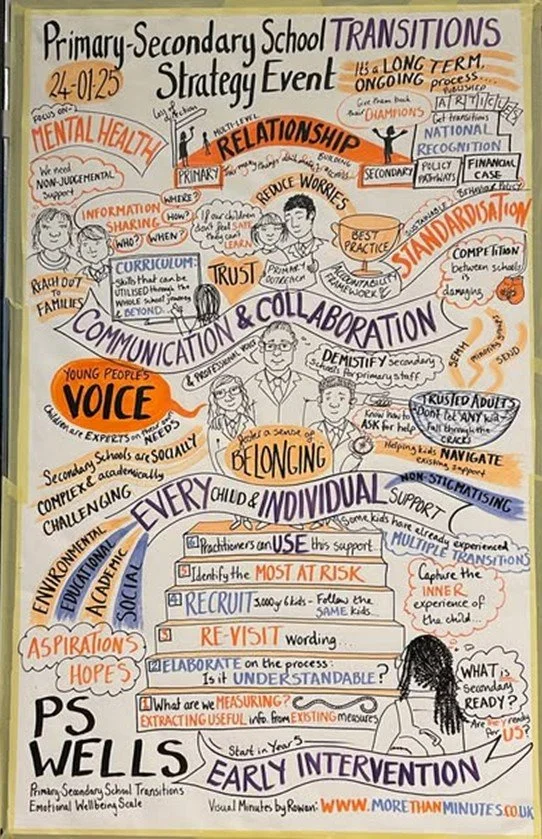
Following our policy-level discussions, we have worked in collaboration to develop a National Transition Strategy for the Children’s Wellbeing and Schools Bill that incorporates #P-S WELLS, and the regional data we have collected. To create our National Transitions Strategy, we held a Primary-Secondary School Transition Strategy Event on 24/01/25 that brought together experts leading on primary-secondary school transitions provision within educational practice, research, and policy. The event generated knowledge exchange in understanding existing barriers and facilitators in implementing “gold-standard” transition provision at the school, Local Authority and national level, and key priority areas (Testimonial 11 & 12).
Testimonials:
Testimonial 11: “I think this was one of the most useful conferences I’ve been to in a while. The fact that it is all working towards something tangible is key to this” (Event attendee)
Testimonial 12: “It was brilliant to hear what other LA’s are doing in terms of transition. I will take back information I have gained today from other professionals and share with my LA” (Event attendee)